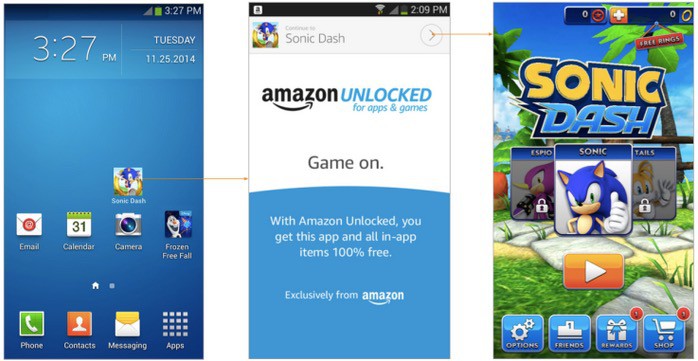

Amazon Coins, the new virtual currency from Amazon that was announced back in February, makes its public debut today. It’s available to Kindle Fire owners who use the Amazon Appstore to download their digital content, and every user in the United States gets 500 coins — worth $5 — free to get them started.
Amazon has today announced that it will be expanding its Android Appstore to almost 200 countries “in the coming months.” Developers can now submit apps in preparation for the expansion, which will see the Appstore rolling out to Australia, Brazil, Canada, Mexico, India, South Africa, South Korea, and many more.
Real Racing 3 is set to get its first update since hitting the App Store back in February, and it’s going to be a big one. In addition to adding two new cars, users will see more than 100 new events, a new game mode, and iCloud save syncing. EA has published a teaser trailer ahead of the update’s release, which shows off the new cars.
Temple Run 2 made a somewhat surprising appearance on iOS yesterday, but as is often the case with new apps and games, there was no word on a possible Android counterpart. Fortunately for those itching to get their hands on the title, there isn’t long to wait. Developers Imangi Studios have confirmed that it will be coming to Google Play and the Amazon Appstore next week.
Apple and Amazon are set to enter settlement talks over Amazon’s use of the term “Appstore,” Bloomberg reports. Apple has filed a trademark infringement lawsuit against the retail giant, claiming that its Android software store could be confused with its own App Store for iOS. A U.S. Magistrate Judge has now ordered the pair to enter talks and try to settle the case ahead of the trial.
Apple launched a temper-tantrum when Amazon decided to title their marketplace for mobiles app as the “Appstore.” Apple was there first and they started using “The App Store” way before anyone else, so they told the United States district court that Amazon is trying to mislead customers.
Not everyone sees things Apple’s way though and the U.S. district court has dismissed Apple’s claims that the Amazon Appstore is false advertising and deceives customers.
Android’s built-in malware scanner can’t be completely trusted just yet.
With its Android 4.2 Jelly Bean upgrade, Google provided its users with extra protection by introducing an extended malware scanner that’s designed to prevent malicious applications from making their way onto your smartphone or tablet. Not only does it scan the apps you download from Google Play, but also those you acquire from third-party sources, such as Amazon’s Appstore.
It gives Android users peace of mind. The only problem is, new research has proven that the feature is largely worthless. When Google’s malware scanner was put through its paces, it was able to detect just 15.32% of malicious apps.
In last year Amazon has become a major player in the Android tablet wars. The Kindle Fire HD is one of the best Android tablets on the market, and Amazon’s software is pretty solid overall.
Sales of the Kindle Fire HD have been strong over the last few months, and Amazon announced today that their Appstore has grown 500 percent.
While the majority of app markets have already adopted this digital scheme, Amazon has just today announced the open availability of their in-app purchasing API. The in-app purchasing API will allow developers to offer digital content to its users in the form of microstransactions. Content such as expansion packs, weapon upgrades, etc. become available to purchase from within the app and usually cost less than a dollar. This monetization model has gained much traction as of late and while the majority of developers implement it in a morally acceptable manner, others simply try to nickel-and-dime users by making their apps virtually useless unless you pony up for the additional content.