
How Google Stores Could Transform Google
googlestores

The site 9to5Google reported this week that an “extremely reliable source” says Google plans to open retail stores later this year.

The purpose of the stores, according to the post, is to sell Google products like the Nexus line of phones and tablets, and also to promote hard-to-understand future items like the Google Glass idea.

The author speculated that Google might also sell Google merchandise like T-shirts.

All this sounds like either crazy talk, or the kind of Apple envy that may have motivated Microsoft to open a chain of retail stores.

But I think Google Stores could be a huge advantage for Google.

Apple Stores are profitable in part because the company sells a small number of highly profitable products. One sale of, say, an iPhone, iPad or MacBook Pro nets Apple not a few dollars, but as many as a few hundred dollars. After a few hundred such purchases, it begins to add up.

Apple Stores also benefit the company as a constant branding effort.

Google, on the other hand sells advertising as its main source of revenue. So how could a big retail presence help Google?

In a nutshell, by communicating difficult-to-understand Google products, services and initiatives.

Apple Stores didn’t use to have that role, because Apple’s products were easy to understand. For example, an iMac or an iPhone is pretty straightforward, and people get it.

But then the iPad came along three years ago, and Apple discovered the third benefit of retail stores.

When Apple first launched the iPad, Apple’s retail stores helped Apple answer the “what’s it for?” question, according to CEO Tim Cook.

What he means is that there is a certain class of product or technology where a mere description can’t convey it’s appeal or value.

When you describe the iPad, it sounds like a terrible product. “Uh, it’s like a laptop without a keyboard and without any processing power and without the ability to run the applications that run on your desktop computer.” That’s a tough sell.

But when you try an iPad, the experience is like: “Wheeeee! I’ve gotta have one!”

Thanks to Apple’s retail stores, the iPad is a hit and everybody gets it now.

So Apple uses its retail presence for three purposes: Sales, branding and to enable potential users to experience products that can’t be appreciated otherwise.

While Apple had or has one “what’s it for?” product, Google has dozens.

For example: Google+, Google Now and the Knowledge Graph, Google Goggles, Google Voice, Google Local, Google Latitude, the Events feature of Google+ and — perhaps most urgently — Google TV.

We geeks get all this stuff. But most of these products and services barely register in the minds of most consumers and, even if they’ve heard about them, don’t understand their value. As a result, all these Google goodies don’t have the interest, mindshare or adoption that they should.

By showcasing all this stuff at a Google Store, Google could set this right.

In addition to actual Google products, Google struggles to inspire behaviors and desires in the minds of consumers that benefit the future that Google desires.

One example is the desire and expectation for high-bandwidth Internet connectivity. Carriers and Internet providers in the US provide over-priced, under-powered connectivity, an have convinced consumers to accept it as normal.

In Google’s ideal world, everyone would have vastly higher-bandwidth pipes, enabling powerful cloud-computing apps, more photo and video sharing and more online everything.

To stimulate demand for higher bandwidth connections, Google spent a lot of money wiring Kansas City with ultra high-speed fiber. But for the vast majority of Google customers, who have never been to Kansas City, the idea remains an abstraction.

By wiring all their Google Stores with fiber connections and letting anyone use it for free, Google could make us all appropriately dissatisfied with our existing Internet connections. Over time, the public would be less accepting of slow connections, and demand much higher bandwidth. Even better, Google could implant the idea that fiber to the device is what enables fast connections, and get us all to demand fiber to the home from our governments and Internet providers.

They could even serve coffee, and Android-themed desserts like ice cream sandwiches and slices of key lime pie.

I can imagine Google Stores as a kind of cross between an Apple Store, a Starbucks and Google I/O — a playground for everybody where Google showcases its marvels, and lets people experience the future as Google envisions it.

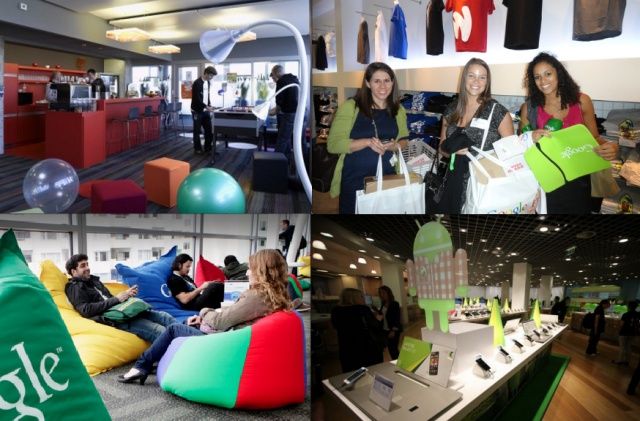
The Google Store could be furnished with Googly furniture like beanbag chairs and little tables where Android devices of every description, as well as Chromebooks and other gadgets are lashed to the tables and connected to the Internet with blistering-fast connections.

I can imagine giant-screens showing live hangouts: When the president or astronauts or Conan O’Brien are doing hangouts, those would be live on screen. When no high-visibility hangouts are scheduled, Google could hook up various stores together into an ambient hangout.

A play area for kids could offer a tiny table with Android tablets showcasing children’s books and apps.

The stores should offer fast free Wi-Fi, so that even if the stores were packed and every beanbag taken, there would be a generalized mob surrounding the entrance to the store, showing the world every day that everybody wants what Google’s got.

Google Stores could serve the same purpose for users that Google I/O does for developers, encouraging education, networking, information and, above all, brand excitement and loyalty.

Google needs users to keep up with where Google is going, and to acquire the knowledge, skills, desires and behaviors that Google needs users to have if the company is to move everything forward.

In a nutshell, the reason Google needs Google Stores is that in addition to building a better Internet, Google needs to build a better user.

Apps you might like

  • Aleksey Maslov

    Cmd+C, Ctrl+V

  • http://twitter.com/GeekyFanboi David Edwards

    So, take an Apple Store, replace the Apple logo with a Google logo, replace the iPhones with Android phones, replace the iPads with Android Tablets, replace the Macs with Chromebooks, rename the Genius Bar, and call it a Google Store? Because that is what I’m picking up from this article.

    • MikeElgan

      If that’s what you’re picking up from this article, then you clearly didn’t read it. I’m saying something very different from that.

      • Matthew White

        As Always Mike thank you for the share.

      • http://twitter.com/lghulm Luke Hulm

        I read the article – it’s what is sounded like to me

      • lucascott

        Yeah, he forgot about the cafe

    • Alex Murphy

      Oh shut up. From Mike’s article it’s pretty obvious a Google Store would be stylistically different from an Apple store.

  • http://ARMdevices.net/ Charbax

    Google to make Google Store because Google is to sell hardware for the first time. Nexus weren’t Google hardware, they were HTC, Samsung, Asus and LG hardware, controlled by HTC, Samsung, Asus and LG. Now, Google is to make their own hardware, thus it only makes sense that Google is going to open 24 stores in the 24 most important cities in the world. Not only in the USA. In there you’ll be able to buy:

    Google Phone 4.3″ 720p: $100 (A7)
    Google Phone 5″ 1080p: $200 (A15/A7)
    Google Entertainment System: $100 (A15/A7, WiiU/PS4/XboX720 killer)
    Google Chromebook 11.6″: $100 (A15/A7, Macbook/Ultrabook killer)
    Google Chromebook Pixel 12.85″: $200 (A15/A7, Macbook/Ultrabook killer)
    Google Tablet 7″: $100 (A9)
    Google Tablet 8″: $150 (A9)
    Google Tablet 9.7″: $200 (A15/A7)
    Google Tablet 10″: $200 (A15/A7)
    Google Watch: $150 (A7)
    Google Reader 6″: $100 (A7)
    Google Reader 9.7″: $200 (A7)
    Google Glass: $400 (A9)

    So basically, the store can have demonstration units on stands in the middle. And once you’re ready to buy, you move to one of the sides of the store where there would be a range of automatic kiosks, do the purchase in advance on the web or on your phone, and simply type in your purchase number, tap your NFC phone, even scan your face to a camera or swipe your credit card or other, or pay with cash in the vending machine, and the automatic kiosk dispenses the product for you in a few seconds.

    Google should provide a recycling service, you can bring back your used Google devices 6-12 months after purchase for a 75% value coupon to buy something else in the store, bring it back 12-24 months after purchase for a 50% of your purchase value in a coupon. Then Google can organize product refurbishing services and thus sell old models refurbished at discounts, also available in store through the vending machines.

    The automatic kiosks vending machines should smoothly connect with large stocks located under the store and in back-rooms. All working automatically with a minimum human intervention.

    Why like this?

    Minimize hardware profit margins, minimize retail costs, and use Internet technology to improve the retail experience.

    Prevent that people ever need to queue in front of your stores.

    Manufactured scarcity is a bogus anti-consumer marketing strategy. Don’t copy Apple on that. Many people can meet in front and at your stores, but not for the wrong reasons.

    When new products are released, people can get them at the store, calmly, without queuing, by simply having purchased and reserved the device beforehand online.

    Don’t compare with LG Nexus 4 and Samsung Chromebook online ordering experiences on Google Play Store. For those, Google did not have control over supply. For the Google Store’s main devices for sale, Google would be in control of supply because Google would be fully funding and controlling the supply, manufacturing and distribution, know exactly how many units are for sale, control manufacturing all the way to retailing.

    Of course, all those products can also be bought online and shipped. The retail stores are just for people who don’t want to wait for shipping and who may want to try the demo units before buying. Retail stores are for demonstrations and for impulse buying.

    Can Google’s partners sell their Android and Chrome OS powered devices in the Google Store too? Yup. Google can provide them with free retail space and add their devices to the vending machines.

    Can you sell your used Android powered devices at the Google Store? yup. Google could find ways to recycle all old Android devices through the store.

    • andrewi

      75% value after 1 year? Dream on. Even at 50% value after 1 year the profit margin is too small, remembering you’re going to have to replace the packaging on all refurb models if you don’t want the place to look like a dodgy pawn shop and the fact that every store costs in the region of $5-$10k minimum to run if you’re paying all your employees at minimum wage level.

      • http://ARMdevices.net/ Charbax

        $200 Chromebook Pixel today is still worth more than $100 refurbished in 1-2 years. That’s just how Google should design and market those devices. Stop the mass pollution of our planet, there is no reason that Google should take part in Apple’s manufactured obsolencence as central part of Apple’s business model. Unlike Apple, Google makes more money the longer people use each device. Thus Google has no interest in seeing the value of their devices drop fast. Apple on the other hand prefers that your brand new iPhone 5 is totally worthless 2 weeks after you buy it, so you already need to buy an iPhone 6.

        • http://twitter.com/lghulm Luke Hulm

          Apple device resale values are the highest in the industry – are you aware of this?

          • http://ARMdevices.net/ Charbax

            Absolutely not true. Anyone can buy an iPhone 4S for about 3-4x lower than the $650 retail price of a year ago. Apple devices are totally worthless right after being sold. Apple designs their products to break fast and need replacement. The iphone has by far the largest percentage of shattered screens, you barely can find anyone with an iPhone whose screen isn’t already shattered. Apple carefully designs their iphones to break within 1-2 years forcing the consumer to buy a new one. Apple is the ultimate implementer of manufactured obsolescence. Apple products are the most overpriced in the world and the most worthless comparatively in resale value.

          • http://twitter.com/MichaelKlipsch Michael Klipsch

            millions of people disagree with you. ive never cracked my iphone screen and ive dropped it hundreds of times. i bet if i dropped a cheap plastic android phone the body and screen would be cracked easily

          • http://ARMdevices.net/ Charbax

            Sciences agrees with me. All scientific tests of durability show that iPhones are the most fragile smartphones on the market. You can barely see anyone on any subway or bus with an iphone which screen isn’t yet cracked, case totally scratched, and if their screen isn’t cracked, ask them if they’ve had a previous Apple device with cracked or significantly scratched surface and they’ll always tell you that they have. http://www.youtube.com/watch?v=elKxgsrJFhw

          • http://twitter.com/MichaelKlipsch Michael Klipsch

            im sitting in an office with 21 people who have iPhones. no broken screens. if it were as rampant as you suggest it is, then there’d probably be at least one with a cracked screen, no? maybe check out who’s running/commissioning those durability tests.

            i know that there are plenty of people with iPhones and broken screens, but maybe thats because the rest of the phone survives. ive seen some android phones hit the ground and shatter into pieces.

            maybe the fact that people can still use their iPhones with cracked screens lends to the fact that the phone IS more durable in other aspects other than the screen.

          • andrewi

            So basically you’re saying; My iPhone is great, but I’ve never seen the other side of the grass so I bet it’s worse.

            And I’ll just remind you that your class is made stronger by plastic, Gorrila glass is a plastic based treatment applied to glass, so I’d watch what you say about ‘cheap plastic’ breaking.

          • http://twitter.com/MichaelKlipsch Michael Klipsch

            i have used multiple android phones and tablets. i know what gorilla glass is. i know that a phone’s body that is made out of plastic feels much cheaper in your hand than the iphone’s metal and gorilla glass body. when i grip my iphone it doesnt make the noise that plastic seams can make.

            i dont know how you surmised that i haven’t used anything other than an iPhone from my post.

          • andrewi

            “I’ve seen some android phones hit the ground and shatter into pieces.” Yet it’s never happened to you.

            My comment ‘Yet you’ve never seen the other side of the grass’ refers to the fact that you have never owned an Android or dropped one. So your talk is pretty speculative. A ‘creaky’ phone (which I’ve actually never encountered) would suggest flexibility in the panels, which is a great way to absorb impacts, so actually you’re contradicting yourself with your yellow speech.

          • http://twitter.com/lghulm Luke Hulm

            Informed opinion on the internet disagrees with you and people can check your evidence with a quick scan of prices on eBay. Your claims are outright fabrications – why do this? Don’t have any real reasons to criticise Apple products so you make them up? FYI I have an iPhone 3GS purchased when they were first released (4.5 years ago) that has had its battery replaced once (after 3.5 years) and still runs the latest OS and gives 2 days of battery life with a decent amount of use. Good luck listing anything comparable from Google. Android devices are cheap, crappy things with poor build quality and resale. Apple devices are precision crafted and have the longest lifespans and resale of ANY products in the industry. People can check this themselves by visiting review sites and around the net.

          • http://ARMdevices.net/ Charbax

            How are iphone 4S sold below $200 not 3 times cheaper than the $650 “new” price?

            You mention it yourself. Iphones, ipods, ipads cannot have their battery changed, which means they get outdated instantly as battery life constantly gets reduced by the limitations of lithium ion technology. Most Android devices sold on the market have removable batteries.

            All science shows it since the start of the iphone. It is carefully built by Apple to loose all its value quickly so consumers feel forced to buy new iphones regularly. Everything from the way the screen cracks, the way the case scratches, the way the battery stops charging, the way jailbreaks get bricked, the way antennas are build to fail. The impossibility to expand on storage capacity. Backwards compatibility on iOS is just not true and is a scam. With iphone 5 Apple instantly also made all the millions of iphone accessories instantly worthless and outdated by forcing apple sheep to invest in a new proprietary connector.

          • http://twitter.com/lghulm Luke Hulm

            Whilst the batteries in Apple products are not USER replaceable they are replaceable by Apple, FOR FREE under warranty and for minimal fees beyond this. As I have said, my iPhone 3GS is 4.5 years old, runs the latest version of IOS buttery smooth and gives over 2 days battery life. Their is not an Android product that can claim the same. iPhones have the highest resale value and reliability in the industry as noted around the net, not just in your fantasies.

    • http://twitter.com/lghulm Luke Hulm

      Do any of those products represent the absolute pinnacle of user experience?
      No? Then why should I care about going in to use them?

      The reason people go into an Apple store is to try exceptional products, not average products. Google would need to life their game before they will find people packing out their stores. A more polished and consistent operating system and UI, apps designed specifically to suit larger screen sizes (rather than being stretched) and a focus on build quality and reducing OS overheads would be a start.

      • http://ARMdevices.net/ Charbax

        Android devices are already considered by all consumers and all professionals of technology to be far far superior to anything Apple does. This has been the fact and case since 2010. Every single version of Android has produced far superior devices than the iPhones and iPads of the time. That fact is fact, just see how over 6 Android phones are sold for each 1 iPhone that is sold and that Android tablets worldwide have already overtaken the iPad volume of sales since the last quarter of 2011.

        Android does not only far outspend Apple on advertising. More than $50 are spent on Android R&D for each $1 that Apple spends on R&D. Apple has a few thousand engineers working on iOS while Android has over 1 million of the worlds top engineers working on the advancement of the Android ecosystem.

        The Google products that are going to be released are going to represent the definite Google platforms, they are the basis that demonstrate the whole ecosystem, they are the true Nexus devices. But with a new layer, made by Google, sold by Google, and with little to no regard to disrupting the whole market. Google, by making and selling its own products is going to dictate the marketing of these technologies.

    • Flitzy

      Chromebook as a Macbook killer? What? Yeah, if you don’t like to be able to install anything and only use Google – yeah, who needs Microsoft Office or anything.. because NOBODY ever uses word processing, right? /rolleyes

      • http://ARMdevices.net/ Charbax

        A large majority of consumers prefer free Google Docs and Google Drive over paid Microsoft Office.

        And you are in no way forced to only use Google, you can use any web service you want.

        And the HTML5 spec allows you to install web apps on your Chrome device, you can in fact run the HTML5 web apps offline anytime you want, that is part of the HTML5 spec. And the web HTML5 web apps can pretty much do anything that your “native” apps in Windows/Mac/Linux would do, including advanced photo editing, advanced video editing, even the future of Adobe Photoshop is cloud based and cloud powered. Native code and 3D are hardware accelerated in HTML5 Chrome OS so even the most advanced app functionalities can work on Chrome OS. If you absolutely want to run Windows/Mac/Linux apps, for the perhaps 2% of consumer uses that still absolutely require using such app, you can still run them using the cloud on Chrome OS simply using remote desktop within the browser.

  • http://twitter.com/earridaram earri daram

    If you think Daniel`s story is incredible…, a month back my girlfriends sister basically recieved a check for $5636 putting in a twenty hour week an their house and they’re roomate’s sister`s neighbour has done this for nine months and made over $5636 part time from a pc. the guidelines from this web-site………. BIT40. ℂOℳ

  • Flitzy

    Yeah, the difference is people *want* to go to an Apple Store while Google is just… boring and bland. They’re trying to do what they always do and copy success but the difference is, Google is just clueless.

    • http://ARMdevices.net/ Charbax

      The difference is 97% of consumers actively seek out to use all Google services on purpose nearly every time they use the web. While just about no consumers would want to use Apple services online like Siri or iTunes if users weren’t forced to use those services because those come as defaults on the Apple devices. Nobody uses Apple nor Microsoft web services on purpose.

      • Flitzy

        Right… nobody uses iTunes, which is why they just sold their ten billionth song.

        And I don’t know about Siri but voice is just impractical no matter who does it – besides, it’s not like Google even has anything comparable.

        Also, clearly “97% of consumers actively seek out to use all Google services” because we know that 100% of statistics are made up on the spot….

        Is Google not the default on Android or Chrome, any way? So you’re theory is pretty shot..

        • Dave Bojanzyk

          iTunes? Now THAT is a garbage program. Can’t believe people still pay $1+ for songs.

          It’s funny you bring up Siri since that is 100% a gimmick feature. I’ve never even heard an iPhone user use Siri. Personal assistants are impractical the way Siri is created just like you said. Except Google Now which is just a voice tool for searching, is actually useful the way it pushes information to you before you even think of it, and gives you search queries within milliseconds from the Knowledge Graph. My colleagues (which are iPhone users) tell me it is the ONE feature that literally kills them they don’t have with their iPhone.

          Let’s make sure we’re all educated before we make assumptions.

          • Flitzy

            Yeah, how DARE people pay for songs. /rolleyes. iTunes is actually pretty wonderful.

            Nothing you replied to was actually about, you know, being educated – it was just tossing opinions. Voice search is so impractical, who is going to go in to a separate app just to do a search? You underestimate it’s worth. I have a Nexus tablet and, honestly, it’s not even worth the horribly blatant privacy violation. One of the first things I did was disable it. I sincerely doubt that people are clamouring for the ability to search Google by voice – I mean, let’s face it, how often are you searching for something any way?

      • http://twitter.com/lghulm Luke Hulm

        Charbax (or Mr fantasyland as you are coming to be known). There are three services people seek out from google – Maps, Gmail & Search. Everything else from Google (Docs, Google+, Android, Drive, Chromebook, Voice/Talk etc) comes in at second best to other products in the market.

        Read Googles annual reports and examine their marketshare in these categories.

        Get this: Google gives all of its products away for free (incl. Android operating system) and YET PEOPLE STILL PREFER the premium priced offerings from Microsoft and Apple. It’s the same way that a Chinese auto manufacturer like Geely may sell a lot of cars (at prices that are virtual giveaways), but people would much prefer a BMW.

        Google = the cheap crap of the technology world for those too poor to afford something better. Apple & Microsoft represent the products that people desire to own and use, and 90% of those that can afford to do so.

        If Google doesn’t give it away for free nobody wants it. Why do you think Google sells everything so cheap? Out of the goodness of their hearts? They are a stockmarket listed company ruled by shareholders who want profit… the reason they don’t get more? The market won’t pay for inferior products. Both Apple and Microsoft trounce Google in profitability. The only ones that contribute meaningfully to Googles bottom line are advertisers. Consumers and business USERS drive Microsofts and Apples bottom line, representing peoples choice to pay for quality. You can’t argue with the figures mate.

        • Dave Bojanzyk

          Everyone I know uses the Google suite from my University. It is in my opinion by far the most superior to any online service. Even my past employers demanded we use it for work and time tracking. There’s a philosophy involved in Linux based technology; that software should be free and only the support should cost money. This has proven to be beneficial in advancement in innovation. Google is the same way. Plus they don’t need you to “buy” their products. Using their products gets them to push ads to you, which they make more money that way anyway. If you’ve learned about Google’s business plan, you’d understand it is the opposite of a traditional corporation. They take all the rules and throw them out the window. It’s about being creative and making new things, and it has put them in control of the internet. That is where the future is.

          • Flitzy

            Google is not a creative company nor a technology company – nor have they ever done anything remotely creative.

            They are an advertising company. Their primary goal is to take you – the product – and sell it to as many people as they can.

  • http://twitter.com/lghulm Luke Hulm

    I posted comments on this site in response to a user below that have been removed. My comments provided concise arguments, were not rude or defamatory but did have have a negative slant on Android and a positive slant on Microsoft and Apple. I believe these companies produce the most highly regarded software and devices in the market and that Google only takes marketshare off these companies by offering alternatives at a far cheaper price. That google marketshare comes from discounting and not by offering quality. Apparently such a view is not allowed to be broadcast on this site. FUCK THE MODERATOR AND FUCK THIS SITE. You can all just sit around and congratulate each other rather than get involved in a real conversation where sacred ducks may be challenged.

About the author

Mike ElganMike Elgan is a Silicon Valley-based columnist who writes about technology and culture. His work appears in a variety of publications, including Computerworld, Datamation, PC World, InfoWorld, MacWorld, ITWorld, CIO, the San Francisco Chronicle. Subscribe to Mike's e-mail newsletter, Mike's List, and follow him on Twitter, Facebook, Digg and elsewhere by visiting http://elgan.com.

email hidden; JavaScript is required| Read more posts by .

Posted in Android, Google I/O 2012, Opinions, Top stories |


scribol