Why I Want Android At Home

androidathome

The next big frontier in mainstream consumer technology is home automation. 

While home automation enthusiasts have been enjoying home automation for years, the vast majority of people don’t have it because it has always been far too expensive and complicated.

But, as we know, Moore’s Law cures all. Suddenly, it’s clear that major Silicon Valley companies are now interested in getting into the home automation space.

It’s all the more interesting because this home automation will be developed as part of the so-called “living room” experience, where every home will have a server that controls not only the all-important DVR recording of Here Comes Honey Boo Boo, but also controls the automated sprinkler system, the heating and cooling systems, the home security system and all the lights.

Although there are literally dozens of specialist companies most of us haven’t heard of doing home automation, it’s more likely that the big companies we’re all familiar with will battle for the future of home computing: Microsoft, Apple and Google are the leading contenders.

Among these companies, Google is currently in last place. Here’s why I want them to win. 

Microsoft is way ahead at present. It’s Xbox gaming system is morphing into a living room media center and home automation system as we speak, and they have both mindshare and marketshare.

Apple has a real shot at home automation — if you look at the newest generation of home automation stuff (which tends to be low-cost, simple and highly modular) — products like Belkin’s WeMo lighting system, the Lockitron keyless entry system, the NEST learning thermostat and others — they either support control by Apple products exclusively, or they favor Apple devices. (The NEST is even for sale in Apple Stores, for crying out loud.)

Google expressed its intention to offer Android-based home automation at Google I/O in 2011. (Here comes the video!)

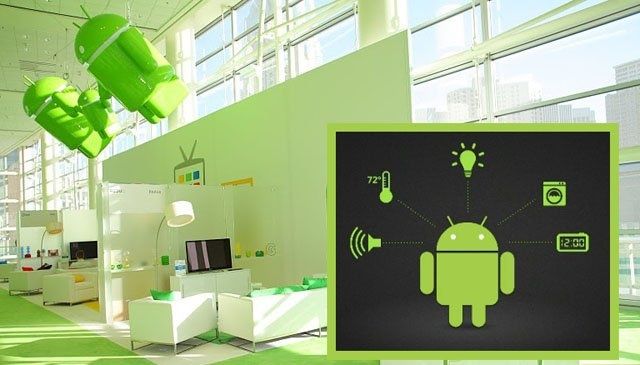
Google’s home automation initiative is called Android@Home.

Now, it’s early days for the new world of modular, low-cost, easy-to-use home automation for everybody. We don’t really know what any of these companies will ultimately offer.

But we do know a LOT about these companies, and how they operate. And based on what we already know, I know I want Google to dominate this space.

Why I Want Google at Home

I understand the religious wars between iOS and Android, and have deep appreciation for both sides.

In a nutshell, the iOS platform offers appliances not meant to be tinkered with. Apple controls everything, and in exchange consumers get a controlled environment where apps play by the rules, have consistent designs and things work very seamlessly without any effort, optimization, customization or anything else required of the user.

Android, on the other hand, offers user control and it gives more latitude to developers to do things their own way. In the phone market, the Android platform offers vastly greater variety and choice in hardware design.

When some random, non-technical relative asks me which phone to buy, the iPhone is a safe recommendation. It will be easy for them to use. They’ll have an Apple Store to go to if it breaks. There’s a place in the world for phones that are integrated appliances like the iPhone or open platforms like Android.

But for home automation? No way. I want Google.

For starters, home automation is a category of a gazillion hardware devices — thermometers, smart beds, lighting systems, GPS dog collars, easy-bake ovens (for grownups), intelligent fire places — we can think of hundreds of categories for home automation products, and there are hundreds more we can’t think of.

I want the platform for this to be a wide-open system like Android, where device and appliance makers can grab the code and run with it without getting permission from a central authority.

There’s another reason. I want home automation tied in with Google Now. I want to talk to my house like it’s a person, and have my house give me information and take action based on our “conversation.”

And it looks like that just might happen.

Don’t Look Now, but Here Comes Android@Home

Android@Home popped up in the Google I/O demo two years ago, then went into hiding.

Suddenly, it’s back!

Google released the 4.2.2 update to Android this week for Google’s three Nexi phone and tablets. Future, top-of-the-line phones will also get the new version.

What’s really interesting about this release has nothing to do with phones or tablets.

A reference to mesh networking in the context of home automation has been spotted in the new code. The reference popped up in the following comment:

Allows access to the loop radio (Android@Home mesh network) device.” 

If you’re unfamiliar with mesh networking, it’s a type of networking that functions a little bit like the Internet itself.

Each device on a mesh network acts as a relay for other devices.

So theoretically an Internet connection could jump from one device to another to the next to the next to the next before arriving at the home router. Mesh network could also enable ad hoc networks. So if somebody introduces a new device into the network that device not only connects to the network on the fly but also enables this connection to be used by other devices.

This is an interesting development for a home automation system. For example, a home security system could connect to the Internet over Wi-Fi and also to a central control computer to handle the home automation tasks. Cameras and lights associated with the home security system could themselves function as essentially Wi-Fi hotspots for the sprinkler system which could provide access and control to the heater and camera in the dog house. This enables the dog house to be connected to the home Internet connection even though it’s too far away from the central router and separated by too many walls.

So that’s exciting. But now for the most promising and awesome news of all: Recently, the same source that found the mesh networking comment discovered many new “com.android.athome” references in new code in Google Now, as well as a reference to a “Card” for turning lights on and off.

(Home automation systems always start with lights, because they’re so simple. The control is either on or off.)

But you can imagine a Google Now “card” for every conceivable home automation appliance in your home.

I don’t know about you, but the very idea of Google Now being the interface for home automation makes me feel all funny inside. (In a good way.)

Like I said, it’s early days for home automation. But you’re going to be hearing a LOT about it over the next five years.

And I hope we see some major Android@Home goodies at the upcoming Google I/O on May 13.

Microsoft is ahead and Apple has a market advantage. But I really want Google’s Android to control my home automation system.

Apps you might like

  • imajoebob

    Here’s why I’m NOT rooting for Android: it’s an out of control mess! It’s bad enough that there are multiple, virtually unsupported releases of Android that may or may not work with all your devices, but there are multiple versions of the same release that may or may not work with your individual devices. Something as basic and innocuous as buying headphones for an Android phone takes as much research as a Masters Thesis. Does it work with my current OS release? Wait, does it work with the current release on the BRAND phone I own?

    Imagine the horror show of trying to integrate the scores of devices in your home with the right release AND brand of phone to control them. What happens if I update my phone? Does the thermostat still work or am I suddenly plunged into sub-zero temperature overnight? Instead of DVRing Phineas & Ferb did my kid just order a months worth of porn from Whips, Wenches, & Wimps? Most important, what happens if my smoke alarm suddenly can’t communicate with my newly patched home security system? I’m (literally) toast.

    I want my automated home systems to run software that’s certifiably reliable by a single source; one that will take responsibility to make sure critical systems work, every time, all the time. I’m even willing to extend the current paradigm: multiple independent systems with reliable software. But there’s no way I want a mish-mash of crappy, decent, and even great components that simply share the same basic language, and try and tell me their patchwork quilt is actually a fine, hand sewn carpet.

    • An0nym0usC0ward

      You’re probably not a programmer, or not one that loves loosely coupled systems.

      For home automation you don’t need the latest and greatest Android version, you just need basic functionality – the code implementing the smart part would actually most likely run anywhere, since it wouldn’t rely on specific APIs. All it would need was a driver for the basic communication protocol implemented by the devices to be controlled.

      Besides, what components you choose to build your home automation system is your choice. You can’t really blame the OS manufacturer for hardware builders putting cheap stuff on the market, and it’s your choice solely to buy such cheap stuff.

      Never had the type of problem you describe with your headphones until now. Whatever I plug into my Asus tablet and my Nexus phone just works.

      • imajoebob

        So I’ll have to buy ALL my home automation equipment from a single manufacturer? No matter how crappy some of their parts may be? For proper, SAFE (completely integrated) home automation you need a SINGLE operating system. Or at the very least one company that actually takes responsibility for the programs. Buying Android is like buying off of ebay: good luck if something goes wrong. That’s fine for buying a used camera, but not managing my home systems.

        • An0nym0usC0ward

          Having an infrastructure doing everything you need built on a single, coherent set of technologies, if possible from a single manufacturer, is IME a myth. In 15+ years of working experience, I have seen several companies who set out to build such a system and ended up nowhere. Why would it be different in the home automation world?

          Why would you expect to get hardware from different manufacturers, but the OS just from one? How about having systems inter-operate based on well defined, standardized protocols, the same way other industries are already doing it? I agree, these protocols have yet to emerge, but IMO that’s the way things will be going, instead of big vendors providing end to end solutions. And having a few competing protocol standards isn’t necessarily a bad thing. In fact, it’s the way the IT industry worked for decades – we constantly had distinct protocols and standards for the same thing, each one better than the other in different situations.

          • imajoebob

            My point is that Android is not, and will never be that system, because they do nothing to control any protocols. When, as in my example, you can’t just buy earphones to control your phone without researching which specific brand and even model works with them, it’s not a viable solution for home security and control systems.

          • bc70

            Every company out there is working on their own proprietary solutions. Even though they may all use zigbee protocol. Companies want to sell you their services so you can’t customize your automation system without paying big bucks.

            They don’t want to play with each other they want your money! Its the 2000′s man! Companies are relying on a services based economy. Once you buy something that’s it! They figured out if you by something and then you can’t do anything to it, you will have to pay them so they keep getting more and more of your money.

            Look at facebook. Less free things and more fee things.

          • An0nym0usC0ward

            You’re right, to some extent, and this will most likely be the business model for automation in hotels, office buildings and the like. But the same way Arduino and similar hardware has established itself as the solution of choice in the hobby market, modular, interoperable solutions will constantly eat into the proprietary hardware market until that market will be limited to a very small part of the industry.

            (I happen to know the business of a local automation provider. He rejects any solution which isn’t openly programmable without any second thought. He has several contracts in the hundreds of thousands of dollars a year, some even bigger, but he isn’t big enough to be considered an important partner for hardware providers like Siemens or Honeywell, for example, and as such he can’t afford vendor lock in – his customers would skin him alive he he told them he can’t support their perfectly working, two years old system anymore because his suppliers have discontinued the hardware line he has used. So the pressure for standardization is already in place. For those smaller integrators – who make up the bulk of the automation market (besides home automation, there’s a huge market for smaller systems, operated by smaller companies, and big companies don’t take the small contracts) – you’d better sell them what they need, if you want their money, or they’ll start rolling their own – this business has at some point built its own devices based on native Java processors, for example, simply because there wasn’t what they needed on the market, and installed a fleet management system based on them on several thousands of vehicles.)

            Look at mainframes. There’s still a market for them, and IBM for example still makes big bucks off mainframes. But nobody builds data centers with mainframes nowadays, and all computers in the top 500 list are built using standard hardware. The proprietary solutions trend happens in every emerging industry, but always passes. It’s simply not efficient, and any industry evolves towards efficiency.

    • bc70

      The problem with those ‘certifiably reliable by a single source’ automation systems like control 4 is that you have to use their crap. The thermostat is what is and it is very expensive at best and very slow. When it won’t work connect or something else you have to pay. I’d rather have an API I can download and mix and match a honeywell thermostat because I know they do them will with some other light switch from Lutron or something rather than paying $175 a light switch for control 4 and $250 for a really crappy thermostat and then pay to have it installed by some control 4 dealer for $200+

      There is not one good unified single source for home automation. Control 4 has not updated their app in a long time and it hangs all the time on my ipad. I end up paying $300/year if I use and ipad and can’t get support from control 4 for their application. If I create my own app for myself it will work for me and I have complete control over the reliability of the application.

      As far as head phones go.. I bet you get your head phones from the apple store or buy ones which say they work with iphone because you don’t know about impedance. That is why people are being imported to take american jobs. People like you want something to ‘just work’ and not now how it works.

  • http://www.facebook.com/people/William-Donelson/1401480685 William Donelson

    The number of detected mobile malware attacks continues to skyrocket. McAfee counts over 36,000 mobile malware threats—almost entirely targeting the Android OS.

    You want this running your home?

    • An0nym0usC0ward

      I absolutely want to run Android on my home automation system, rather than any closed system, since most attacks nowadays target the stupid user, not some intrinsic software vulnerability.

      • xared

        So you say this is a solution for smarties and not the typical home user? Who just wants something that works?

        I bet you would also say that autorun viruses on windows spread (and exist!) thanks to stupid users and are not a fault of the OS itself.

        • An0nym0usC0ward

          > So you say this is a solution for smarties and not the typical home
          > user? Who just wants something that works?
          Absolutely. If you’re not a fanatic DIY-er, you wont build your own home automation system. If you are, you definitely want something open – and you qualify for the smarties category. If you prefer to order your system ffrom a professional, that processional qualifies as a smartie. Do you think MS, Apple or Google will come to your home and set up a system linking the media center, the lighting, the heating, the air conditioning, the plant watering and whatnot into a single system? It’s either DIY or a local professional/tinkerer.

          > I bet you would also say that autorun viruses on windows spread (and
          > exist!) thanks to stupid users and are not a fault of the OS itself.
          Again, absolutely. As a qualified (i.e. not stupid) user, you’re supposed to know what you run. Getting a CD image from a dubious origin and running it doesn’t qualify as not stupid. It’s the computer equivalent of driving late at night into a dubious neighborhood just because you received an anonymous call asking you to do so, or entering all your credit card info on a site you never visited before, and of which you don’t have any references.

        • Logan Kraus

          Yes, it is almost always the user’s fault. I have never used any sort of antivirus software, and have never gotten a virus. As long as you don’t start downloading everything in sight from any random website or spam email, you should be fine. Chances are, if your computer gets a virus it’s because you downloaded something you shouldn’t have or went to a website you shouldn’t have been on.

          • Shachar Lerer

            No anti virus? And no virus ever? I guess you’ve never been connected to a university’s network before. And just for the sake of it, how DO you know that you don’t have any virus /malware if you don’t use an anti virus?

  • An0nym0usC0ward

    I don’t want Android to win. I want Linux for home automation. And the way things are going, I think there are good chances that it’s going to happen.

    Home automation is a hardware and low level programming thing. It’s not an OS thing. Whoever is doing it already relies heavily on Arduino or similar. Since the rasp.pi came out, several me-too devices in the same direction followed, and home automation tinkerers build their system on them. Guess what: many of those run Linux.

    This means the companies active in that area are going to make money on hardware and services, less on OS and software. Even if this won’t be the case, provided the home automation companies won’t be Apple, Google and MS, there’s no incentive for anybody else to license and then sell an OS they don’t own, when there’s a perfectly usable free alternative. And the way I see it, it will definitely not be one of these who will make a break-through in home automation – they simply don’t focus on the right thing, and doing the right thing won’t be lucrative enough for them. They all are specialized in providing the same product or service in many instances, whereas there aren’t two identical home automation systems. None of them has the experience and culture to build up a system of hundreds of thousands of individual consultants which should be able to implement the right system for each customer.

    Most wireless routers, many NAS-es and also many media centers run Linux without the owner even being aware of it, for the same reason – it was cheaper and easier to take a free, open and highly flexible OS and build your own platform on top of it, instead of licensing a proprietary OS, on which development is more difficult. Why wouldn’t the same thing happen with home automation appliances? If it’s about tinkering, Linux beats iOS, Android and W8 by far.

    • xared

      Even though some embedded systems do run linux RTOSes, they can have different protocols for home automation. Insteon, X10, Zwave are just some of the popular ones. With each manufacturer having to choose one of these, how would you manage the entire system? Fragmentation here too.

      With no sight of any standards committee implementing a single protocol for home automation, it really doesnt matter if android or linux is the OS, the protocols just wont mix.

      The best way out of this mess is if one of the big players jump into the fray. Apple, Microsoft or maybe even Samsung can be that one. Samsung has loads of home appliances already, and can do a good job of making a single seamless home automation system, with one protocol. If they would just do it already.

      • An0nym0usC0ward

        I’d expect USB to become cheap enough on Arduino in a very short time to make all other BUS types obsolete, between intelligent devices. And I’d expect some serial standard to emerge, simpler than USB, to connect to dumb sensors/actuators. This would solve the DIY-er’s problem completely, wouldn’t it?

        OTOH, it’s in the nature of tinkerers/Linux hackers to not mind having to live in a rich and non-uniform ecosystem – that’s what makes it a healthy ecosystem. If you look at the current landscape of Linux solutions, that’s exactly the case – you have lots of distinct destkop managers, database servers, web servers, vector and bitmap drawing programs, remote desktop/ssh clients, even a few alternatives for office packages.

        Suppose Samsung jumps in, and creates the perfect suite of sensors, actuators and intelligent appliances. Do you really think they’ll be able to cover 100% of the needs of 100% of all people wanting home automation? With an open system, the 10% of functionality not covered out of the box will cost you maybe two times the cost of the 90% what’s available by default. With a closed system, the additional costs could be 1000%.

        Having many competing protocols isn’t that bad, IMO, if you look at the hardware landscape of the moment. As long as there isn’t a single dominant system, hardware manufacturers will release their products in variants supporting each major protocol, or maybe release multiprotocol versions. Which, again, is IMO a requirement for a healthy ecosystem – no single clear winner in the protocol market.

  • NutjobNumber1

    Home automation? That can range from a simple turn on/off a light bulb to the entire house with lots of whiz bang cool features. I would look at what the high end guys are doing just to see what’s possible and go from there. Crestron, AMX, Smarthome, Control 4 and Savant seem to be the bigger players. From my own personal research, I like Savant the best, they have some of the coolest features that the others simply can’t do. But Android based? Are you talking the control device? All of them except Savant can use an Android or iOS device or their own supplied WIndows CE tablet, remember those? But these all have to be professionally installed because they are complicated if you want it done right with all of the whiz bang features. “Idon’t know about you, but the very idea of Google Now being the interface for home automation makes me feel all funny inside. (In a good way.)” ???? Check out Savant Systems GUI, it’s about the coolest GUI on the market out of all of them. You can take pictures of the room at different vantage points and program things in the picture to activate it. Coolest GUI out there. Sorry, but it’s iOS only.

About the author

Mike ElganMike Elgan is a Silicon Valley-based columnist who writes about technology and culture. His work appears in a variety of publications, including Computerworld, Datamation, PC World, InfoWorld, MacWorld, ITWorld, CIO, the San Francisco Chronicle. Subscribe to Mike's e-mail newsletter, Mike's List, and follow him on Twitter, Facebook, Digg and elsewhere by visiting http://elgan.com.

email hidden; JavaScript is required| Read more posts by .

Posted in Android, Opinions, Top stories |


scribol