
iFixit Dissects The Samsung Galaxy Note 10.1, Hopes Apple Is Taking Notes
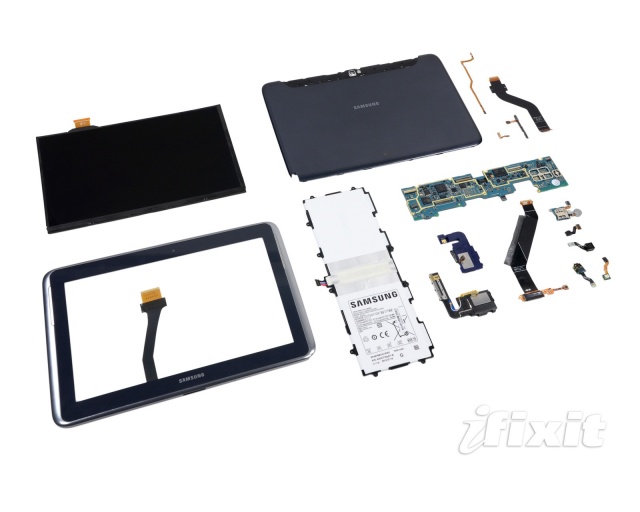
The Samsung Galaxy Note 10.1 made its debut last week and has already found its innards spread across a table for all to see. That’s right, I’m talking about the customary iFixit teardown. That’s when a member of the iFixit team dissects a device to expose its parts and determine its level of repairability. You’ll be happy to know the Samsung Galaxy Note 10.1 scored an 8 out of 10 for ease of repair, completely shaming Apple’s new iPad, which barely scored a 2.
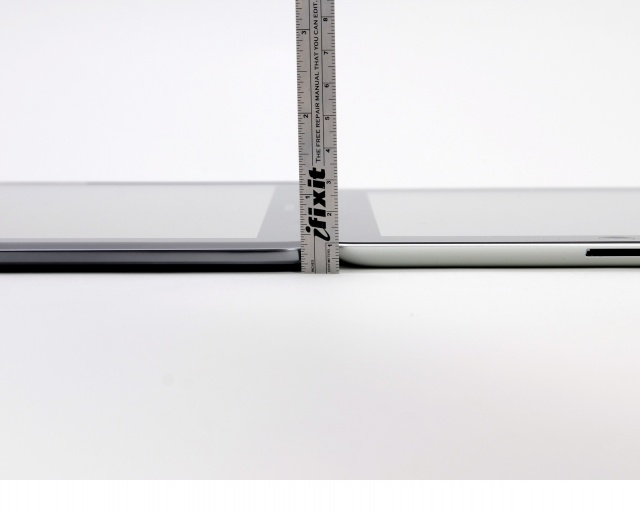
Most of you will never have the need or desire to open up your device, but should you ever have to, it’s nice to know the task won’t be too difficult. The Galaxy Note 10.1 proves that you can make a tablet that’s thin and easily repairable (a fact the iFixit team thinks Apple should take note of).
Teardown highlights:
- A few Phillips screws, a few clips, and we’re in! We like this combination: the screws are enough of a hassle to keep out meddling kids, but will by no means deter anyone who needs to fix anything inside.
- Our first look inside the Note 10.1 greets us with a cornucopia of connectors. By our count, there are 16! Having a lot of connectors is a huge boon for repairability. When components can be easily accessed and removed, repairs cost less and customers are more apt to fix their devices.
- Neither the 5 MP rear camera nor the 2 MP front camera are notable in and of themselves, but the fact that they are independent components (as opposed to sharing a single cable) is pretty cool.
- The battery is quite easy to remove, even though a few cables have to be disconnected first. It’s rated at 3.7 volts, 7000 mAh, and 25.90 watt-hours.
- Just like in the new iPad, the battery in the Note accounts for a large portion of the device’s weight. It weighs in at 136 grams, roughly 23 percent of the 594-gram device.
- The EMI shields in the Note are screwed in. We don’t recall seeing that before, and we’re quite thankful we don’t have to bust out the soldering iron and dental picks (no, seriously) in order to uncover the chips underneath. Props to you, Samsung.
- In addition to protecting important motherboard components from electromagnetic interference, it appears that these EMI shields also serve as the Note’s heat sinks.
- Major players on the motherboard include the following:
* Samsung Exynos 4 Quad 1.4 GHz processor with integrated 3D graphics
* Wacom W8008 (we assume this is used for S Pen input)
* Atmel mXT1664S touchscreen controller
* Samsung KLMAG2GE4A NAND flash memory
* Wolfson Audio WM1811AE audio codec
* F0514A 430 1201KP411 - Just like all of the components that we disconnected in the first few steps, the dock connector can be removed by simply detaching a connector and unscrewing a pair of screws. More points for repairability!
- Repair enthusiasts everywhere rejoice! The front glass and LCD can be separated and replaced individually.
iFixit applauds Samsung for using good ol’ Phillips screws, refraining from glueing the LCD to the front glass, and providing a modular internal layout. All of which allows the Note 10.1 to be repaired inexpensively and without specialized tooling.
Kudos to you Samsung.
For a full look at the teardown, hit up the source link below.
- SourceiFixit


