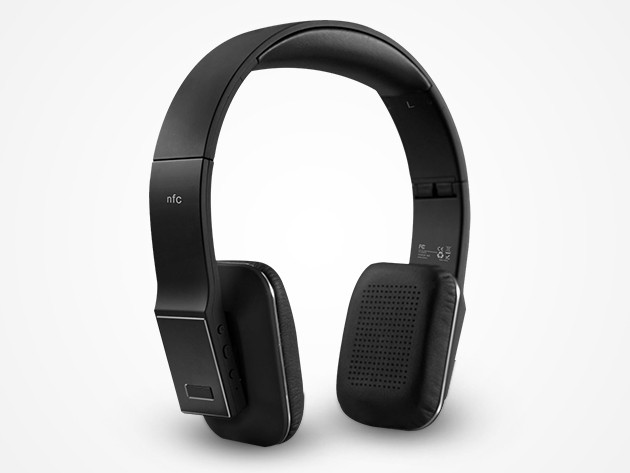

“Affordable” isn’t a word you would normally associate with high-quality Bluetooth headphones, because you usually have to spend a small fortune to get a set that sound truly great. But that’s no longer the case, thanks to The Runaway Collection from MEElectronics.
For just $57 — with $43 off for a limited time — you can bag a pair of AF32 Bluetooth stereo headphones that look great and sound terrific. They’re sleek and super comfortable, and Bluetooth connectivity means that they’re also completely wireless.
Are they for UFC fighters who want to listen to music while they’re actually throwing punches in the ring? For talk-radio listeners who get violent when they hear opinions they don’t agree with? Or just for clumsy goofs who’re always destroying their headphones (you know who you are). Whatever the reason for the over-engineered Jabra Revos existence, the headphones ship today.
Noise-cancelling headphones are suddenly all the rage. It certainly seems as if every big player in the audio game has at least one model that features active noise-canceling, usually accompanied by other luxury features — and with a corresponding luxury pricetag. Even manufacturers who’ve only recently begun making cans, like Logitech UE and Klipsch, prominently feature active noise-canceling in their model lineups.
It may even seem as if the technology has been added to some models simply because it’s become the feature du jour — an impression strengthened by the fact that not all noise canceling is the same. Not even remotely.
None of the headphones in our showdown — the Klipsch Mode M40 ($350), the Logitech UE 6000 ($200) or the Monster Inspiration ANC ($300), the noise-canceling version of the regular, passive Inspiration model we reviewed last year — exhibits the powerful noise-canceling ability that can almost completely drown out noise, like that of the Bose QuietComfort 15. Nor do they sit on the next level down, with NC performance similar to, say, Audio Technica’s ATH-ANC7b (although one here comes close).
If you live in the United Kingdom and you’re planning on picking up the Xperia Z, then you might want to get your order in as early as possible. Sony is giving those who pre-order before February 27 a free pair of its MDR-1R headphones, which usually sell for $299.99 (approx. £190).
When one company swallows another, it’s common for a slow shift in rebranding and design to occur as the two entities thrash out their roles and relationship. The latest shift in the Logitech-Ultimate Ears story — Logitech purchased UE in 2008 — occured a month or so ago, when Ultimate Ears was rebranded as Logitech UE and launched a suite of high-end, blue-tinged soundware, with a product selection that reached far beyond the in-ear monitors the company has thus far been known for. In fact, out of seven new gadgets, just one new IEM was introduced: the Logitech UE 900 ($400), a quad-armature earphone that now sits at the pinnacle of UE’s non-custom earphone line.
The UE 900 has lineage, of course; we loved the snug fit, solid build and amazing sound of its antecedent, the TripleFi 10. But the TripleFi 10 is gone, and the UE 900 has stepped into its place with new ergonomics, a new sound — and a lot of blue.
There isn’t anyone with a model catalog quite like Sony (how the hell do they keep track of these things?). The company has just refreshed their line of midpriced, bass-heavy MDR-XB headphones with three new models, replacing four previous ones.
The three new models, the XB800 ($150), XB600 ($100) and XB400 ($60), all follow Sony’s headphone design template: soup-bowl sized, perfectly circular cups attached to massive headbands (the headband on the XB800 is so formidable it looks like it could maybe double as a helicopter landing strut).
I remember saying something to the effect that these Monster Inspiration headphones (passive noise isolation, $300) looked like fluff when I first encountered them at the Consumer Electronics Show earlier this year. Boy was I wrong.
Discovering great headphones from a company that specializes in making bags was surprisng at first, when we reviewed Incase’s Sonic headphones late last year. A month later we were less stunned when we grunted in approval at their Capsule in-ear ‘phones during our budget(ish) canalphone shootout.
This time around we played with a new denim-clad version of the on-the-ear IncaseReflex headphones ($80) — which sit between the $150 over-the-ear Sonic and the canalphone Capsules — and came away with the impression that the Reflex may very well be the best bang-for-buck of the bunch.
You’re an American, and you’ve just watched your athletes come away with a barrel full of gold medals in London. Maybe you’re feeling a little patriotic; maybe a little like you want to go out and train for Rio de Janiero. If so, then Monster has created the perfect earphones for you: A special edition “USA” version of their impressive, washable, iSport IEMs.
We bumped into neophyte Australian headphones-maker Audiofly in January, during a press-only event at this year’s Consumer Electronics Show, and gave two models in the four-model lineup a whirl. Their mid-level AF45 set sounded great for $50; but the next one I tried — the top-of-the-line AF78 ($200) — left me slack-jawed with disbelief; its sound knocked my socks off, even amid the cacophony of noisy journalists.
What makes the AF78 unusual is its speaker arrangement.
Many mid-to-high-end canalphones are powered by tiny armature speakers, while moving coil drivers are found pretty much everywhere except the very high end. Armatures are generally better at producing clean highs and mids, but can lack deep bass; moving coils, on the other hand, are generally not as good at reproducing the clarity of an armature. But the AF78 is part of an elite group of models — like the Scosche IEM856m I reviewed last year — that employ both a moving coil speaker and a balanced armature in each ear, in an attempt to give the listener the best of both worlds. And it works spectacularly.